

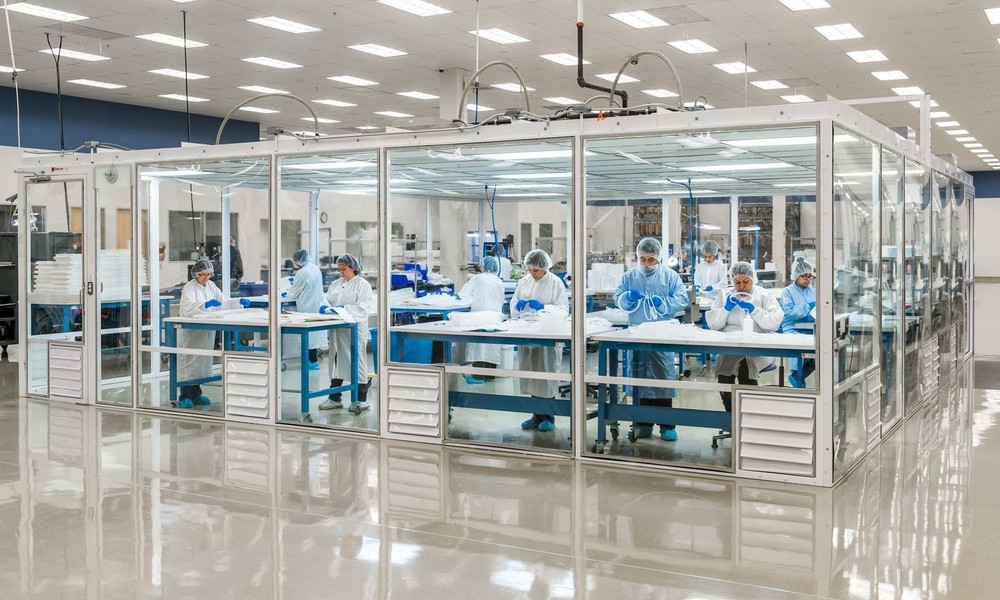
Manufacturers producing components that contact patients or enter sterile surgical fields operate a clean room for medical devices to prevent contamination and meet regulatory requirements. Cleanroom environments control airborne particulate levels, temperature, humidity, and microbial contamination through engineered air handling, strict gowning protocols, and continuous environmental monitoring. AMT, a precision manufacturer based in Singapore, operates ISO Class 7 and Class 8 cleanroom facilities dedicated to medical device production, assembly, and packaging.
Why Cleanrooms Matter in Medical Device Manufacturing
Patient Safety and Contamination Control
Particulate contamination on medical device surfaces poses a direct risk to patient health. Foreign particles introduced during manufacturing can cause adverse tissue reactions, interfere with device function, or compromise sterile barrier packaging. Cleanrooms reduce these risks by filtering the air supply through HEPA filters that capture 99.97 percent of particles at 0.3 micrometres and larger, maintaining a controlled environment where contamination sources are minimised.
The consequences of inadequate contamination control extend beyond patient harm. Product recalls triggered by contamination events damage brand reputation, incur significant financial costs, and attract heightened regulatory scrutiny during subsequent inspections. Operating a properly classified cleanroom prevents these outcomes by addressing contamination at its source.
Regulatory Requirements
Regulatory frameworks including FDA 21 CFR Part 820 and ISO 13485 require manufacturers to control the production environment for devices where contamination could affect safety or performance. ISO 14644 defines cleanroom classifications based on maximum allowable particle concentrations per cubic metre of air. Medical device manufacturers must demonstrate that their production areas meet the appropriate classification for the devices being produced.
As Singapore’s Senior Minister of State for Health Koh Poh Koon stated, “Patient safety depends on manufacturing standards that leave no room for compromise on quality.”
Cleanroom Classifications for Medical Devices
Different medical device categories require different levels of environmental control. AMT operates cleanrooms at two classifications:
- ISO Class 7 (equivalent to former Federal Standard 209E Class 10,000): supports production of implantable devices, sterile surgical instruments, and drug delivery components that demand stringent contamination limits
- ISO Class 8 (equivalent to Class 100,000): supports assembly and packaging of non-implantable devices, diagnostic components, and sub-assemblies that require controlled but less restrictive environments
The classification determines maximum particle counts, air change rates, pressure differentials, and monitoring frequency. AMT’s facility design maintains positive pressure in cleaner zones relative to adjacent areas, preventing contaminated air from migrating into production spaces through doorways and pass-throughs.
AMT’s Cleanroom Infrastructure
Facility Design and Air Handling
AMT’s cleanroom suites feature ceiling-mounted HEPA filter modules that deliver laminar or turbulent airflow patterns suited to each room’s classification requirements. Air handling units maintain specified temperature ranges between 20 and 24 degrees Celsius and relative humidity between 40 and 60 percent. Return air grilles positioned at low wall levels create a downward airflow pattern that sweeps particles away from work surfaces and product zones.
The facility includes dedicated gowning rooms where personnel don cleanroom garments, gloves, face masks, and shoe covers before entering production areas. Gowning procedures follow validated sequences, and AMT’s quality team conducts periodic gowning effectiveness audits to verify that personnel practices meet required standards.
Environmental Monitoring Programme
AMT’s environmental monitoring programme tracks conditions in clean room for medical devices operations on a defined schedule. Particle counters sample air at designated locations during production shifts. Settle plates and active air samplers collect microbial samples for incubation and colony counting. Temperature and humidity data loggers record conditions continuously, with alarm thresholds set to alert facility personnel if parameters drift outside qualified ranges.
All monitoring data feeds into AMT’s quality management system, where trends are analysed during management review meetings. Adverse trends trigger investigation and corrective action before conditions deteriorate to the point of affecting product quality or cleanroom classification.
Cleanroom Operations and Personnel
Training and Qualification
Every person who enters AMT’s cleanroom areas completes an initial training programme covering contamination science, gowning procedures, material handling, and cleanroom behaviour rules. Refresher training occurs at defined intervals, and AMT tracks individual training records to ensure that only qualified personnel perform medical device cleanroom production activities.
Behavioural discipline matters as much as facility design. Rapid movements, unnecessary talking, and improper material staging all generate particles. AMT’s cleanroom supervisors monitor adherence to protocols and address deviations promptly to maintain the controlled environment.
Material and Equipment Controls
All materials entering the cleanroom pass through airlocks or pass-through chambers. Packaging is removed in ante-rooms, and components are transferred on clean carts or trays. Equipment surfaces are wiped down with approved cleaning agents before entry. AMT’s cleaning validation protocols specify agents, methods, and frequencies for each cleanroom area, ensuring that surfaces remain within acceptable contamination limits.
Supporting Regulatory Compliance
AMT’s cleanroom facilities and monitoring programmes generate the documentation that device companies need during regulatory audits and product registration reviews. Environmental monitoring reports, facility qualification records, personnel training logs, and cleaning validation data form a comprehensive evidence package that demonstrates ongoing compliance with ISO 14644 and applicable device-specific standards.
Device companies working with AMT receive access to relevant facility qualification reports and monitoring summaries for inclusion in their own regulatory submissions. This transparency supports cleanroom manufacturing for medical devices partnerships built on shared quality objectives and regulatory preparedness.
For manufacturers seeking controlled production environments that protect both patients and products, a clean room for medical devices at AMT’s Singapore facility provides the infrastructure, monitoring discipline, and compliance documentation that the medical device industry requires.
